
Most venue operators and event planners believe bar capacity is simply about counting heads, but this oversimplification leads to uncomfortable guests, regulatory violations, and lost revenue. Understanding how capacity calculations work requires grasping legal frameworks, layout dynamics, and practical safety considerations. This guide demystifies bar capacity for London’s vibrant hospitality scene, covering calculation methods, Licensing Act 2003 requirements, layout impacts, and real venue examples. Whether you’re hosting after-work drinks or planning corporate events, accurate capacity planning ensures memorable experiences whilst maintaining compliance with local authorities.
Table of Contents
- Understanding Bar Capacity: What It Means And Why It Matters
- How Seating Arrangements And Layouts Impact Bar Capacity
- Legal And Safety Considerations Under The Uk Licensing Act 2003
- Real-World Examples And Practical Tips For Planning Bar Capacity In London
- Frequently Asked Questions About Bar Capacity
Key takeaways
| Point | Details |
|---|---|
| Capacity calculation basics | Divide usable floor area by space per person based on your chosen layout style |
| Legal framework matters | UK Licensing Act 2003 sets capacity limits to ensure public safety and prevent nuisance |
| Layout dramatically affects numbers | Theatre seating allows 0.5 sqm per person whilst cabaret requires 1.2 sqm per person |
| Compliance protects your licence | Exceeding capacity risks fines, licence reviews, and permanent revocation |
| London venues vary widely | Typical central London bars range from intimate 80-person spaces to 320-capacity pubs |
Understanding bar capacity: what it means and why it matters
Bar capacity represents the maximum number of guests a venue can safely and legally accommodate at any given time. This figure isn’t arbitrary. Venue capacity calculation starts with a simple premise: divide your total usable floor area by the space required per person for your chosen layout. A 200 square metre venue configured for standing reception at 0.5 sqm per person theoretically holds 400 guests, whilst the same space arranged as cabaret seating at 1.2 sqm per person accommodates just 167 people.
Accurate capacity planning directly impacts three critical outcomes. First, guest comfort determines whether your event feels exclusive or overcrowded. Cramped conditions lead to negative reviews and damage your venue’s reputation amongst London’s discerning professional crowd. Second, revenue optimisation means maximising attendance without sacrificing experience quality. Underestimate capacity and you leave money on the table; overestimate and you create safety hazards. Third, legal compliance protects your operating licence and avoids penalties from local authorities.
The consequences of miscalculation extend beyond immediate discomfort. Venues that consistently exceed licensed capacity face enforcement action, including temporary closure orders and permanent licence revocation. Conversely, conservative estimates that artificially limit bookings reduce profitability and competitive positioning. In London’s saturated bar market, where professionals seek venues for private hire events, getting capacity right separates thriving establishments from struggling ones.
London’s financial district presents unique capacity challenges. After-work crowds surge between 17:00 and 20:00, demanding flexible layouts that accommodate both standing networking and seated dining. Venues must balance peak demand periods with quieter midweek sessions whilst maintaining consistent safety standards. Pro tip: calculate capacity for your busiest anticipated scenario, then work backwards to ensure all configurations meet regulatory requirements without compromising guest experience.
How seating arrangements and layouts impact bar capacity
Different seating arrangements require dramatically different space allocations per person, fundamentally altering how many guests fit comfortably in your venue. Theatre-style seating, where rows face a presentation area, needs just 0.5 sqm per person because guests remain stationary throughout the event. Classroom layouts, adding tables for note-taking, increase requirements to 1.0 sqm per person. Banquet configurations for formal dining demand 1.2 sqm per person to accommodate tables, chairs, and service access. Standing receptions theoretically work at 0.5 sqm per person, though practical comfort suggests 0.7-0.9 sqm for professional networking events where guests mingle freely.
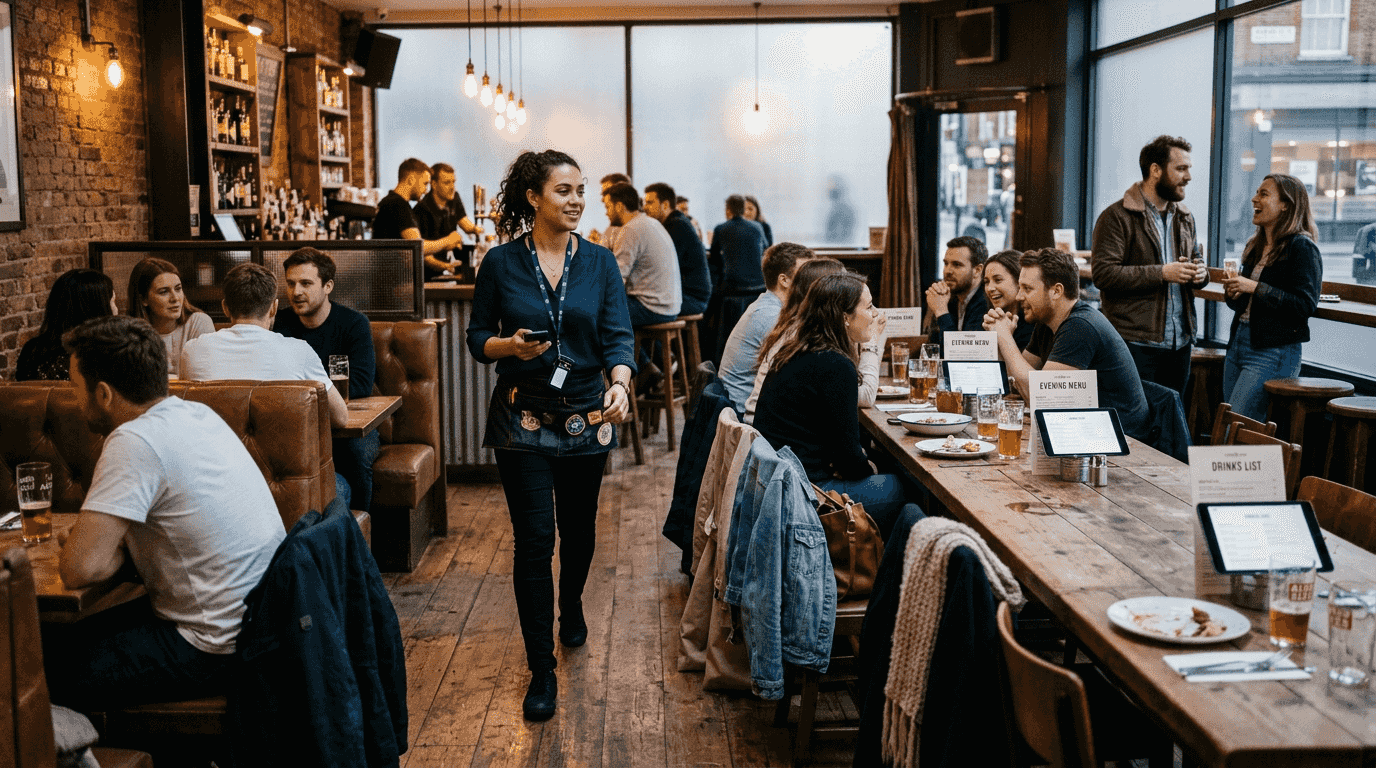
The table below illustrates how layout choices directly impact capacity calculations for a standard 150 square metre London bar venue:
| Layout Style | Space Per Person | Theoretical Capacity | Comfortable Capacity | Best Use Case |
|---|---|---|---|---|
| Theatre | 0.5 sqm | 300 | 250 | Presentations, performances |
| Standing reception | 0.5 sqm | 300 | 200 | Networking, cocktail parties |
| Classroom | 1.0 sqm | 150 | 130 | Workshops, training sessions |
| Banquet | 1.2 sqm | 125 | 110 | Formal dinners, celebrations |
| Cabaret | 1.2 sqm | 125 | 100 | Dining with entertainment |
Layout selection profoundly affects event atmosphere and guest interaction patterns. Theatre and standing configurations maximise numbers but limit personal space and movement. These work brilliantly for hosting events in cocktail bars where energy and buzz create memorable experiences. Banquet and cabaret layouts reduce capacity but enhance intimacy and conversation quality, ideal for corporate dinners or celebration meals where relationship building matters more than headcount.
London venues frequently adapt floor plans to match event objectives and client preferences. A versatile bar might operate as standing reception for Friday after-work drinks, transform to cabaret for Saturday evening entertainment, then reconfigure as theatre for Sunday afternoon presentations. This flexibility demands careful planning and staff training to execute transitions safely whilst maintaining licensed capacity limits.
Pro tip: when planning networking events for London professionals, aim for 0.8 sqm per person in standing configurations rather than the theoretical 0.5 sqm minimum. This extra space facilitates comfortable conversation clusters, reduces perceived crowding, and allows efficient bar access. Your guests will appreciate the breathing room, leading to longer stays and higher per-head spending. Following the bar hire guide for London helps ensure layout choices align with both capacity constraints and event success metrics.
Legal and safety considerations under the UK Licensing Act 2003
The Licensing Act 2003 provides guidance to licensing authorities on the discharge of their functions, establishing four statutory objectives that directly influence capacity determinations. These objectives are preventing crime and disorder, ensuring public safety, preventing public nuisance, and protecting children from harm. Licensing authorities use capacity limits as a primary tool to achieve these goals, particularly public safety and nuisance prevention in densely populated areas like London’s financial district.
Local councils set maximum capacity as conditions on premises licences following consultation with police, fire services, environmental health officers, and community representatives. These limits consider multiple factors beyond simple floor area calculations:
- Building structure and emergency exit provisions
- Fire safety equipment and evacuation procedures
- Toilet facilities and sanitation capacity
- Ventilation and air quality systems
- Noise containment and neighbour impact
- Staff numbers and crowd management capability
Regulatory enforcement has intensified in 2026 following several high-profile incidents. Recent case example: Westminster Council conducted a regulatory review of outdoor areas at Walkers of Whitehall pub amid resident complaints about noise, overcrowding, and antisocial behaviour. The review resulted in stricter outdoor capacity limits, mandatory security presence during peak hours, and enhanced noise monitoring requirements. This demonstrates how capacity decisions balance commercial interests against community wellbeing.
Council conditions on outdoor capacity and behaviour reflect growing emphasis on responsible hospitality. Venues must now demonstrate robust capacity monitoring systems, including electronic counting at entry points for larger establishments. Staff training on capacity management has become mandatory, with documented procedures for refusing entry when limits approach. Failure to maintain these standards triggers licence reviews that can result in reduced capacity, restricted operating hours, or complete revocation.
Compliance importance cannot be overstated for London venue operators. Fines for capacity violations start at £5,000 but escalate rapidly for repeat offences or incidents involving injury. Licence reviews damage reputation and create uncertainty that affects bookings and investor confidence. The London nightlife guide landscape has seen several established venues lose licences permanently in 2025-2026, demonstrating authorities’ willingness to enforce regulations strictly.
Licensing authorities must have regard to this guidance when carrying out their functions under the 2003 Act. It is a key medium for promoting best practice, ensuring consistent application of licensing powers, and for promoting fairness and transparency in decision-making.
This statutory guidance emphasises that capacity limits aren’t suggestions but legal requirements backed by criminal sanctions. Venue operators must treat capacity management as seriously as food hygiene or employment law compliance. Regular audits, staff training updates, and proactive engagement with licensing authorities demonstrate responsible operation and reduce enforcement risk.
Real-world examples and practical tips for planning bar capacity in London
Wetherspoon’s is opening a new pub with a capacity of 320 customers next to Charing Cross Station, providing a useful benchmark for central London venue scale. This 320-person capacity represents a mid-sized establishment suitable for mixed use, accommodating both casual drinkers and organised group bookings. Comparing capacities across London’s diverse venue landscape illustrates how location, layout, and target market shape capacity planning.
Typical London bar capacities vary significantly by venue type and positioning. Intimate cocktail bars in Shoreditch or Soho often operate at 60-100 capacity, prioritising atmosphere over volume. Mid-sized bars in Canary Wharf or the City, targeting professional after-work crowds, typically accommodate 150-250 guests with flexible layouts. Large format venues like the Wetherspoon example handle 300+ customers, requiring sophisticated crowd management and multiple service points. Understanding these benchmarks helps event planners set realistic expectations when exploring Broadgate alternatives for corporate functions.
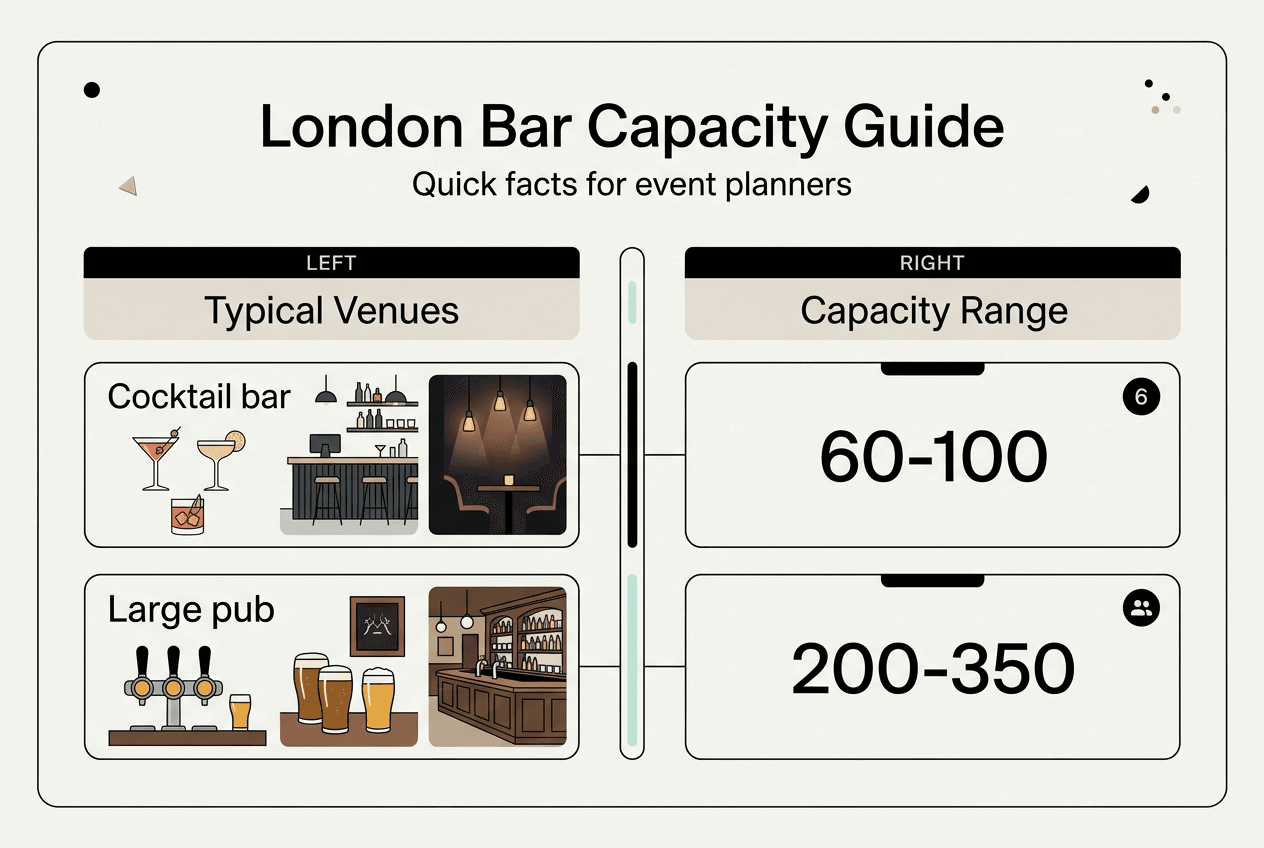
The following comparison illustrates typical London bar categories and their capacity characteristics:
| Venue Type | Typical Capacity | Primary Layout | Best Use | Location Examples |
|---|---|---|---|---|
| Boutique cocktail bar | 60-100 | Standing/cabaret | Intimate gatherings | Soho, Shoreditch |
| Professional bar | 150-250 | Mixed/flexible | After-work events | City, Canary Wharf |
| Large pub | 250-350 | Standing/banquet | Group celebrations | Central stations |
| Venue hire space | 100-200 | Customisable | Private functions | Financial district |
Step-by-step capacity planning ensures your event succeeds within legal and practical constraints:
- Measure usable floor area accurately, excluding bars, kitchens, storage, and restricted zones
- Select layout style based on event format, guest expectations, and networking objectives
- Calculate theoretical capacity using appropriate space per person metrics from layout guidelines
- Review licensed capacity limits on the venue’s premises licence to ensure compliance
- Reduce theoretical capacity by 15-20% to account for practical comfort and movement patterns
- Anticipate guest behaviour, particularly for standing events where clustering around bars reduces effective space
- Plan monitoring procedures including entry counting, staff observations, and contingency protocols
- Confirm emergency procedures and ensure all staff understand capacity-related safety responsibilities
Pro tip: engage with licensing authorities early when planning events that approach venue capacity limits or involve outdoor areas. Westminster, City of London, and Tower Hamlets councils appreciate proactive communication and often provide helpful guidance on compliance requirements. This relationship building prevents last-minute complications and demonstrates responsible operation that protects your venue’s reputation.
Monitoring capacity on event night requires visible systems and empowered staff. Electronic counters at entry points provide accurate real-time data for larger venues, whilst smaller establishments use manual clicker counts or wristband systems. Designate a senior staff member as capacity manager with authority to pause entry when limits approach. Clear communication with door staff, bar teams, and event organisers ensures everyone understands current numbers and threshold triggers.
The bar location benefits in London for professionals extend beyond convenience to include venues’ capacity planning sophistication. Establishments in the financial district have refined their systems through years of hosting demanding corporate clients who expect seamless experiences. Learning from these operational best practices helps newer venues avoid common pitfalls whilst building reputations for reliability and safety.
Discover perfect venues for your next London event
Planning an event that balances capacity, atmosphere, and guest experience requires choosing venues that understand these dynamics intimately. The 1 Bar London specialises in creating memorable experiences for professionals seeking vibrant social spaces in the heart of the financial district. Located at 18 Appold Street, the venue combines expertly crafted cocktails with live music performances, offering an upscale ambiance perfect for after-work networking and celebration events.
Our private hire options provide flexible capacity solutions tailored to your specific event requirements, whether you’re hosting an intimate team celebration or a larger corporate function. The venue’s layout adapts to different group sizes and event formats, ensuring optimal guest comfort whilst maintaining the energetic atmosphere that makes London’s bar scene exceptional. Understanding the advantages of hosting events in cocktail bars helps you appreciate how venue choice directly impacts networking success and guest satisfaction. Explore our offerings to discover how professional venue management and capacity planning create events your guests will remember.
Frequently asked questions about bar capacity
What factors influence the maximum capacity of a bar venue?
Maximum capacity depends on usable floor area, chosen layout style, licensed limits set by local authorities, emergency exit provisions, toilet facilities, and ventilation systems. Space per person ranges from 0.5 sqm for theatre seating to 1.2 sqm for banquet layouts, directly affecting how many guests fit comfortably. Licensing authorities also consider fire safety equipment, staff numbers, and crowd management capability when setting legal capacity limits.
How do local licensing laws affect bar capacity in London?
The Licensing Act 2003 requires London councils to set capacity limits that ensure public safety and prevent nuisance to residents. Westminster, City of London, and Tower Hamlets councils actively enforce these limits through regular inspections and respond to community complaints with licence reviews. Venues exceeding licensed capacity face fines starting at £5,000, potential licence restrictions, or permanent revocation in serious cases.
What should event planners consider when choosing a bar for private hire?
Evaluate the venue’s licensed capacity against your expected guest count, allowing 15-20% buffer for comfort. Confirm layout flexibility to match your event format, whether standing networking or seated dining. Review the venue’s capacity monitoring systems and staff training to ensure professional crowd management. Following an exclusive bar hire guide helps identify venues with proven capacity planning expertise.
How can I ensure my event stays within legal capacity limits?
Implement entry counting systems using electronic counters or manual clickers, and designate a senior staff member as capacity manager with authority to pause admissions. Communicate current numbers regularly to door staff and bar teams, establishing clear protocols for approaching threshold limits. Reduce theoretical capacity by 15-20% for practical comfort, and maintain documented procedures that demonstrate compliance to licensing authorities.
Are there typical capacities for different styles of London bars?
Intimate cocktail bars typically accommodate 60-100 guests, mid-sized professional bars handle 150-250 people, and large format pubs serve 250-350+ customers. Venue hire spaces often offer 100-200 capacity with customisable layouts for private functions. These ranges vary based on location, target market, and layout flexibility, so always confirm specific licensed capacity rather than assuming based on venue type. Consulting a comprehensive bar hire guide for London provides detailed capacity expectations for different venue categories.