
TL;DR:
- Effective private event planning requires clear goals, detailed requirements, and a realistic budget.
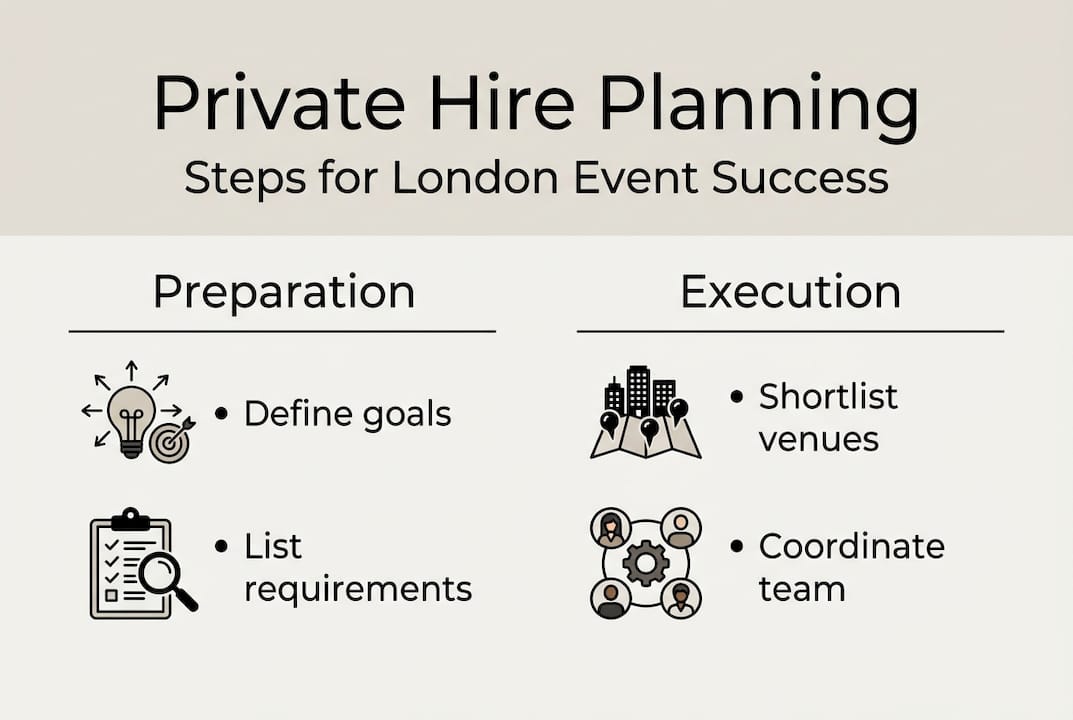
- Shortlisting venues involves evaluating location, capacity, amenities, and costs using a structured comparison.
- Successful events depend on seamless communication, thorough verification, and personalized touches to create memorable experiences.
Picture this: you’ve promised colleagues a brilliant evening out, the invitations are sent, and excitement is building. Then, two days before the event, you realise the venue has no AV equipment, the caterer never confirmed, and the minimum spend is double what you budgeted. What should have been a memorable night becomes a logistical nightmare. Private hire events in London deserve better than last-minute scrambling. This guide walks you through a clear, proactive planning process, from setting goals and shortlisting venues to coordinating communications and verifying every detail, so your event runs smoothly and leaves a lasting impression on every guest.
Table of Contents
- Identifying your goals and requirements
- Shortlisting venues and gathering information
- Managing communications and coordination
- Troubleshooting and verifying event readiness
- Our perspective on optimising private hire for London events
- Unlock unforgettable moments with The 1 Bar’s private hire solutions
- Frequently asked questions
Key Takeaways
| Point | Details |
|---|---|
| Plan with clarity | Define your event’s objectives, requirements, and budget before searching for venues. |
| Compare venues efficiently | Use tables and checklists to evaluate locations by amenities, cost, and suitability. |
| Communicate proactively | Keep written records and clear contacts with venue staff to prevent surprises. |
| Verify all arrangements | Final checks ensure technical, catering, and staffing details are sorted for stress-free events. |
Identifying your goals and requirements
Every successful private hire event begins long before you speak to a single venue. Clarifying event goals is a critical first step, and skipping it is the single fastest route to wasted budget and disappointed guests. Before anything else, sit down and answer the fundamental questions.
Start by nailing down your guest count. Is this an intimate team celebration for 20 people, or a large corporate networking evening for 150? The number shapes every decision that follows, from room size to catering quantities. Alongside headcount, define the event type clearly. A product launch has very different requirements to a birthday party or an after-work drinks reception.
Next, list the features your event genuinely needs:
- Audio-visual equipment: screens, microphones, or a DJ setup
- Catering style: canapes, a seated dinner, or a drinks-only package
- Accessibility: step-free access, lifts, and accessible toilets
- Ambiance: formal, relaxed, themed, or branded
- Location: proximity to public transport or the City
Once your requirements are listed, build your budget. A realistic budget includes not just the venue hire fee but also catering, entertainment, décor, and a contingency of at least 10 to 15 per cent for unexpected costs. The table below gives a simple framework for structuring your event budget:
| Budget category | Estimated percentage of total |
|---|---|
| Venue hire fee | 35% |
| Catering and drinks | 40% |
| Entertainment and AV | 10% |
| Décor and branding | 5% |
| Contingency | 10% |
Pro Tip: Always ask about minimum spends and capacity limits when you first contact a venue. These two figures will immediately tell you whether a space is viable for your event, saving you hours of back-and-forth. You can explore private hire options early in your research to benchmark what London venues typically include in their packages.
With a clear understanding of your goals and requirements, you can begin mapping out the practical steps for successful private hire.
Shortlisting venues and gathering information
Once you know what you’re looking for, the next step is to efficiently shortlist venues and create an actionable information bank. This phase is where disciplined research pays dividends. Rather than visiting every venue that catches your eye, use a scoring system to filter your options before committing time to site visits.

Identify venues that match your event profile by focusing on three core filters: location, capacity, and style. For London professionals, proximity to transport hubs and the financial district matters enormously. Guests arriving from Canary Wharf, Bank, or Liverpool Street will appreciate a venue that’s easy to reach after work. Comparing venues by amenities and cost enables data-driven decision making rather than relying on gut feel.
When researching venues, gather the following information for each option:
- Capacity: minimum and maximum guest numbers
- Hire fee structure: flat fee, minimum spend, or both
- Included amenities: AV, furniture, staffing, and bar service
- Exclusivity: whether the space is fully private or shared
- Booking flexibility: cancellation and amendment policies
In 2026, average venue hire costs in London range considerably depending on location and exclusivity. A semi-private area in a central bar typically starts around £500 to £1,500, while a fully exclusive venue in the City can range from £2,000 to £8,000 or more for an evening. Understanding this range helps you filter out venues that are clearly outside your budget before wasting time on enquiries.
Use a comparison table to keep your shortlist organised:
| Venue | Capacity | Hire fee | AV included | Exclusivity | Transport links |
|---|---|---|---|---|---|
| Option A | 80 | £1,200 | Yes | Full | Excellent |
| Option B | 120 | £2,500 | Partial | Shared | Good |
| Option C | 60 | £800 | No | Full | Excellent |
This kind of structured comparison prevents you from falling in love with a venue purely on aesthetics. You can also review private hire venue advantages to understand what separates a good venue from a truly exceptional one for your specific event type.
With venue information in hand, the next priority is making sure your communications and coordination are seamless and reliable.
Managing communications and coordination
Poor communication is responsible for more event disasters than any other single factor. Effective communication reduces the risk of event day surprises, and yet it’s the area most planners treat as an afterthought. The moment you begin engaging with venues, treat every interaction as a professional transaction with a paper trail.
Follow these numbered steps to keep your coordination tight from first enquiry to event day:
- Send a structured initial enquiry: include your event date, guest count, requirements, and budget range in your first message. This saves multiple rounds of back-and-forth.
- Request a written proposal: ask the venue to confirm all inclusions, fees, and policies in writing before you proceed.
- Schedule milestone check-ins: agree on specific dates for confirmations, such as four weeks out, two weeks out, and three days before the event.
- Confirm all supplier arrangements in writing: caterers, entertainers, and AV technicians should all receive written briefs with timings and contact details.
- Distribute a final run sheet: share a detailed timeline with all parties at least 48 hours before the event.
Pro Tip: Keep a dedicated folder, whether digital or physical, containing every email, contract, and confirmation related to your event. If a dispute arises on the day, having a written record resolves it in minutes rather than hours.
‘Clarity from day one is your strongest insurance against last-minute headaches.’
This principle applies equally to internal communications with your own team. Assign clear ownership for each task, whether that’s managing the guest list, liaising with the caterer, or greeting guests on arrival. Ambiguity in roles creates gaps, and gaps create problems. The bar hire step-by-step guide offers further detail on structuring your coordination timeline effectively.
After planning and communicating, the last step before the event is verifying every detail is in place.
Troubleshooting and verifying event readiness
The final phase before your event is verification, and it deserves as much attention as the planning stages that preceded it. Verifying all arrangements is vital for a successful private hire event, yet many planners skip thorough checks in the belief that everything is already sorted. It rarely is.
Run through the following checklist in the week before your event:
- Catering confirmed: final menu, dietary requirements, and service timings agreed with the caterer
- Technical setup verified: AV equipment tested, microphones checked, and any presentation slides loaded and working
- Staffing confirmed: venue staff numbers, bar team, and any external suppliers briefed on timings
- Guest communications sent: final details, directions, and dress code reminders distributed to all attendees
- Access and security: confirm who holds keys, entry codes, or security passes for the venue
Use a confirmation table to track the status of each critical element:
| Element | Confirmed by | Confirmation date | Back-up plan |
|---|---|---|---|
| Catering | Venue manager | 5 days prior | Local restaurant on standby |
| AV equipment | Technical supplier | 3 days prior | Portable speaker hired |
| Bar staffing | Venue coordinator | 3 days prior | Agency staff booked |
| Guest list | Event organiser | 2 days prior | Digital copy on phone |
Handling last-minute changes requires a calm, methodical approach. Identify the two or three elements that would most seriously affect the guest experience if they failed, and build a specific back-up plan for each one. If the AV fails, what is your alternative? If a key supplier cancels, who can step in?
Pro Tip: Carry a printed copy of all confirmations, contact numbers, and the event run sheet on the day itself. Technology fails at the worst moments, and a paper backup has saved many an event planner from a very stressful evening.
You can find further detail on the bar hire benefits for events that come from working with an experienced venue team who actively support your verification process.
Our perspective on optimising private hire for London events
Here’s something most planning guides won’t tell you: booking a venue is the easy part. The real work is in the nuance. After years of experience in London’s event scene, the pattern is clear. The events that guests remember and talk about months later are never the ones with the biggest budgets. They’re the ones where someone took the time to personalise the details.
The myth that logistics equal success is surprisingly persistent. Planners tick every box on the checklist and then wonder why the evening felt flat. What separates a functional event from a genuinely memorable one is intentionality. A thoughtfully chosen playlist, a welcome drink tailored to the season, a small branded touch at each table. These details cost very little but signal to guests that someone genuinely cared.
Busy planners often overlook one powerful shortcut: leaning on the venue’s own expertise. Experienced venue teams have seen hundreds of events and know what works. Ask them what they’d recommend, not just what’s available. That conversation often surfaces ideas you’d never have considered.
You can explore what a fully exclusive bar hire guide looks like in practice to understand how the right venue partnership elevates your event beyond the ordinary.
Pro Tip: Invest at least 20 per cent of your planning time in personalising the guest experience, not just managing logistics. That’s where the memorable moments are made.
Unlock unforgettable moments with The 1 Bar’s private hire solutions
If you’re ready to put this planning process into action, The 1 Bar at 18 Appold Street in the heart of London’s financial district is built for exactly this kind of event. Whether you’re organising an after-work celebration, a corporate gathering, or a milestone birthday, the team here knows how to make it work.
The 1 Bar’s private bar hire services include bespoke packages covering cocktails, entertainment, and full venue exclusivity, all supported by an experienced team who will guide you through every step. Start with the booking guidance for private events to understand your options and get in touch with the team to begin planning your next standout London event.
Frequently asked questions
How far in advance should I begin the private hire planning process?
Early planning increases venue availability and cost effectiveness, so starting at least two months ahead is strongly recommended, particularly for popular London venues during busy periods.
What are the most common mistakes when planning private hire events?
Lack of clarity on requirements, poor communication, and skipping final verification checks are the most frequent mistakes, and proper verification and communication are the most reliable ways to avoid them.
Are there venues in London that offer bespoke packages for private hire?
Many venues, including The 1 Bar, provide tailored hire packages, and venue packages can include custom catering, entertainment, and décor to suit your specific event needs.
How do I manage last-minute changes before a private hire event?
Keep back-up plans ready for each critical element, confirm arrangements with all suppliers in advance, and assign one person to handle urgent issues on the day, as having back-up plans ensures smooth resolution when unexpected problems arise.