
TL;DR:
- Proper preparation, clear requirements, and contract review are essential for successful London event planning.
- Systematic venue comparison, site visits, and understanding pricing models prevent costly mistakes.
- Thorough pre-event checks and contract negotiations safeguard against hidden charges and last-minute issues.
Picture this: it’s the evening of your corporate function, guests are arriving, and you suddenly realise the contract never confirmed your exclusive access time. The bar is still serving the public. Nobody told you about the minimum spend penalty clause buried on page four. Scenarios like this play out across London every week, and they almost always stem from the same cause: skipping steps in the venue hire process. This guide gives you a structured, practical framework for hiring a London cocktail bar venue, covering everything from initial preparation and venue comparison to contract review and day-of checklists, so you can host with total confidence.
Table of Contents
- What to prepare before hiring your venue
- Step-by-step venue search and comparison
- Booking and contract essentials: avoiding hidden pitfalls
- Final preparation and run-of-event checklist
- Why most London event hires go wrong (and how to get it right)
- Make your next event unforgettable at The 1 Bar
- Frequently asked questions
Key Takeaways
| Point | Details |
|---|---|
| Preparation matters | Define your event requirements and prepare documentation before starting your search. |
| Compare venue options | Evaluate venues side-by-side on cost, capacity, and contract flexibility. |
| Read contracts closely | Carefully review all terms, focusing on payment, cancellation, and force majeure. |
| Plan for surprises | Have contingency plans for weather, timings, and attendee numbers to avoid extra charges. |
| Thoroughness pays | A step-by-step venue hire process helps avoid expensive mistakes and ensures a successful event. |
What to prepare before hiring your venue
Strong events begin long before you ever set foot inside a venue. The groundwork you lay in the first phase determines how smoothly everything else unfolds, and for London events especially, where competition for premium spaces is fierce, arriving unprepared means losing out.
Start by clarifying your event specifics in writing. This means locking in the purpose of the event (is it a corporate networking evening, a private birthday, a product launch?), your expected guest count, your preferred date and any acceptable alternatives, and the rough running order. Vague briefs lead to mismatched venues and awkward negotiations.
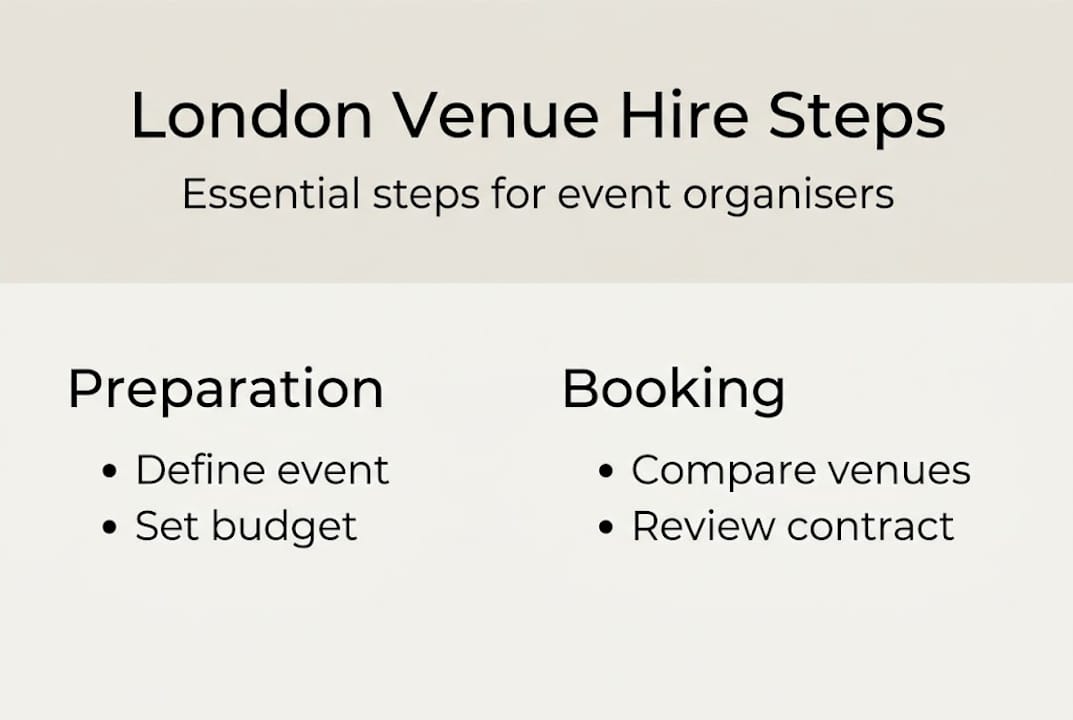
Next, set a realistic budget. Factor in not just the hire fee itself, but also catering, staffing, decorations, AV equipment, and a contingency buffer of roughly 10 to 15 per cent. Many organisers fixate on the room cost and forget the surrounding expenses that inflate the final bill.
Here is a quick reference table for your requirements data:
| Requirement | Detail to confirm |
|---|---|
| Guest count | Minimum and maximum expected |
| Event type | Corporate, private, celebratory |
| Date and time | Preferred date plus two alternatives |
| Budget | Total spend ceiling including extras |
| Must-have amenities | AV, bar, catering, private access |
| Required documents | ID, proof of address, deposit method |
When it comes to documentation, have the following ready before you make any enquiry:
- Valid photo ID for the lead organiser
- Proof of address or business registration
- Preferred deposit payment method (bank transfer or card)
- Public liability insurance certificate if required by the venue
- Any licence or permit requirements for your event type
For corporate events or larger gatherings, some London venues will also ask for a risk assessment or event management summary. Having these prepared in advance signals professionalism and speeds up the approval process enormously.
As part of your brief, follow a step by step bar hire approach from the outset, mapping each task against a timeline. It keeps you accountable and prevents the creeping delays that cost organisers their preferred dates.
Pro Tip: Always review contract essentials such as payment terms, cancellation, force majeure, liability, guest numbers, and timings before you even shortlist venues. Knowing what you are looking for in a contract makes your early conversations far sharper.
Step-by-step venue search and comparison
Once your requirements are documented, you move into the discovery phase. This is where many organisers either rush ahead excitedly or become paralysed by too many options. A structured sequence keeps you focused.
- Search broadly. Use venue directories, recommendations from colleagues, and Google searches for your event type and location. Cast the net wide before narrowing.
- Shortlist ruthlessly. Apply your non-negotiables (capacity, location, exclusivity, budget) to eliminate venues immediately. Aim for a shortlist of three to five.
- Book site visits. Never hire a venue without visiting in person. Photos flatter. Acoustics, natural light, access points, and staff manner only reveal themselves on site.
- Rate each venue against your criteria. Use a scoring matrix to remove subjectivity from what can otherwise become an emotional decision.
- Compare costs and charging models. This is where most organisers get caught out.
Understanding minimum spend vs per-person charging models is critical for contract negotiations in bar hire. A minimum spend agreement requires your group to spend a set amount across the bar over the course of the evening. A per-person rate charges a flat fee per head. The difference matters hugely if attendance drops or drinks consumption is lower than expected.

Here is a comparison table to apply during your shortlisting:
| Criterion | Venue A | Venue B | Venue C |
|---|---|---|---|
| Capacity (max) | 80 | 120 | 60 |
| Location (tube access) | Excellent | Good | Excellent |
| Exclusive hire available | Yes | No | Yes |
| Minimum spend | £2,000 | £3,500 | £1,500 |
| AV and tech facilities | Full | Partial | Basic |
| Private bar access | Yes | Shared | Yes |
When reading venue marketing materials, look past the lifestyle photography. Ask specifically about what is not included: does the quoted price cover staff, or are they extra? Is the AV equipment operated by venue staff or self-service? What is the noise curfew?
For events in London’s financial district, an exclusive bar hire guide will help you understand the full scope of what exclusive hire actually means versus a semi-private arrangement. Equally, understanding the nuances of private hire in the financial district will help you ask the right questions during site visits and shortlisting.
Pro Tip: Always ask venues for a sample contract during the shortlisting phase, before you commit emotionally to a space. Red flags in the contract can save you from a venue that looked perfect on site.
Booking and contract essentials: avoiding hidden pitfalls
You have found your venue. Now comes the part that separates experienced organisers from those who learn hard lessons. Signing a venue hire contract without a thorough review is one of the most costly mistakes in event planning.
Here is a step-by-step approach to the booking process:
- Request the full contract in advance. Do not accept a verbal summary. Read every clause.
- Negotiate before you sign. Venues expect questions. Pushing back on unfavourable terms is normal and professional.
- Confirm the deposit structure. Understand exactly what you are paying now, what is due later, and under what circumstances deposits are retained.
- Clarify cancellation and rescheduling terms. Ask specifically whether you can convert a cancellation into a credit rather than losing the deposit entirely.
- Secure written confirmation of every verbal promise. If a staff member offers you a free round of drinks or an extra setup hour, it must appear in writing.
“Always review key contract clauses covering payment, cancellation policies, force majeure, liabilities, damages, supplier approvals, and setup and teardown before committing to any venue hire agreement.”
Several clauses are routinely overlooked by even experienced organisers. Force majeure defines what happens if the event cannot proceed due to circumstances outside anyone’s control (extreme weather, civil disruption, public health events). Post-2020, this clause carries enormous practical weight. Liability clauses specify who is responsible if a guest is injured or property is damaged. Supplier approval clauses restrict which external suppliers (caterers, photographers, DJs) you may bring into the venue.
For cocktail bars specifically, watch for:
- Low-attendance penalties: some venues charge extra if your final guest count falls significantly below the booked number
- Overrunning charges: running beyond your agreed end time often incurs a per-hour charge, sometimes at a premium rate
- Corkage or external drinks restrictions: bringing outside alcohol to a cocktail bar venue almost always violates the contract
Reviewing event contracts for cocktail bars with a clear checklist before you sign protects both your budget and your event’s reputation.
Final preparation and run-of-event checklist
With a signed contract in hand, the focus shifts from legal protection to operational excellence. Thorough pre-event coordination is the difference between a smooth evening and a chaotic one.
In the week before your event, confirm the following:
- Access times for setup (earliest entry and latest exit)
- Staffing arrangements: who is the venue’s on-the-night point of contact?
- Technical checks: AV, lighting, microphones, and connectivity tested
- Catering confirmations: timings, dietary requirements, service sequence
- Signage and branding placement approved by the venue
- Guest list shared with venue security if required
On the day itself, run through this checklist in sequence:
- Arrive early to oversee setup personally
- Walk the space with the venue manager and confirm all arrangements match the contract
- Test all AV and music settings before guests arrive
- Brief your own team or hosts on roles, timings, and emergency contacts
- Confirm bar tab limits or drink tokens if applicable
- Have a printed copy of the contract and all confirmations on hand
Edge cases require pre-planning, not improvisation. Severe weather contingencies, overrun charges, and attrition penalties are among the most common sources of unexpected costs and disputes, and they matter far more since the pandemic underlined how quickly circumstances can shift. Know in advance what the venue’s policy is if fewer guests attend than contracted, or if the event needs to finish early.
You can significantly reduce day-of stress by using a system to streamline private hire planning that accounts for these variables before they arise.
Pro Tip: Request copies of the venue’s public liability insurance certificate at least 48 hours before your event. If something goes wrong on the night, you want to know exactly what cover is in place and who to contact.
Why most London event hires go wrong (and how to get it right)
After years working in London’s event and hospitality scene, the pattern behind most venue hire failures is depressingly consistent. It is rarely bad luck. It is almost always shortcuts.
Organisers skip the detailed brief because they are excited. They skip the contract review because they trust the sales manager they liked during the site visit. They ignore edge cases because they assume the worst will not happen. Then it does.
Here is the contrarian view: spending an extra two or three days on negotiation and preparation almost always pays back in tangible ways. A rescheduling clause negotiated upfront costs you nothing. A force majeure clause added after signing can cost you everything. Venues in the City respect organised clients and are far more likely to throw in extras (a complimentary cocktail hour, extended setup time) when they see you know what you are doing.
The benefits of private bar hire in London are real, but they are only fully realised when organisers do the work. A beautiful venue hired carelessly is still a liability. A modest venue hired meticulously can deliver an exceptional event every time. Do not let impatience undermine the experience you have invested in building.
Make your next event unforgettable at The 1 Bar
You now have the framework. The next step is finding a venue that makes the process genuinely straightforward.
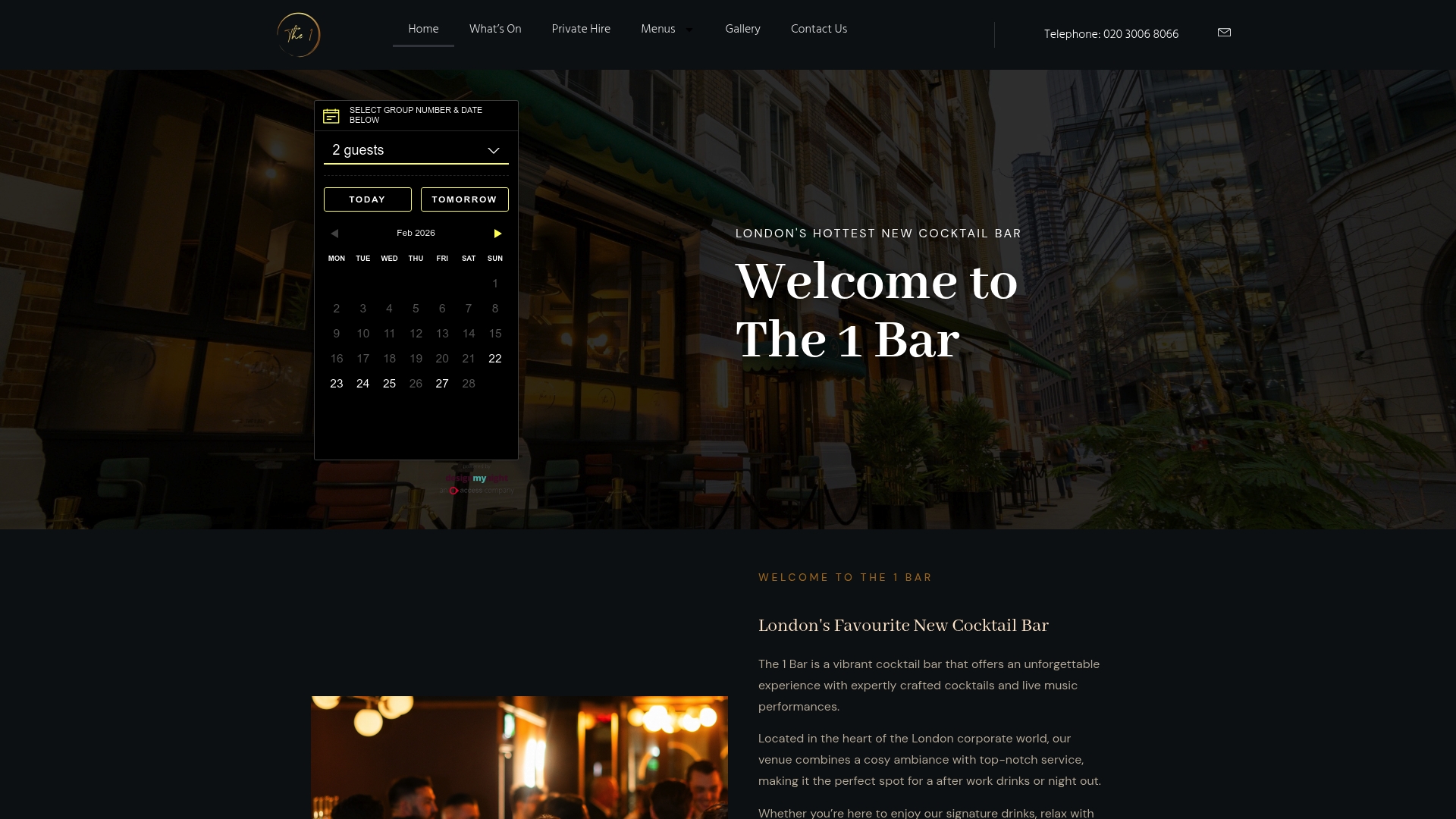
The 1 Bar London at 18 Appold Street is a vibrant cocktail bar in the heart of the financial district, designed for exactly the kind of events this guide prepares you for. Whether you are planning a corporate networking evening, a private celebration, or an exclusive after-work gathering, the team here understands what professional organisers need: clarity, flexibility, and a space that impresses. Explore the full range of private hire options and get step-by-step support through the guide to booking private hire. Get in touch directly to discuss your event requirements.
Frequently asked questions
What key clauses should I check in a London venue hire contract?
Always review payment terms, cancellation policy, force majeure, liability, damages, and approved suppliers before you sign. Missing even one of these can expose you to significant financial risk.
What is the difference between minimum spend and per-person rates?
Minimum spend vs per-person rates affect flexibility differently: minimum spend sets a total bill threshold, while per-person rates charge for each guest regardless of consumption. Both carry distinct contract risks depending on your expected attendance.
How can I avoid paying full cancellation fees for a venue?
Book well in advance to access better refund terms, and negotiate rescheduling credits or deposit transfers rather than outright cancellation. Some venues will agree to resell credits if they fill the slot with another booking.
Why are force majeure clauses so important post-COVID?
Post-COVID force majeure clauses are now essential because they protect organisers when events are cancelled for reasons entirely outside their control. Without one, you may be liable for the full hire fee even when cancellation was unavoidable.