
Why live music draws patrons: the social spark of London nights

TL;DR:
- Live music fosters social togetherness, emotional arousal, and unique shared experiences.
- It significantly impacts venue revenue, loyalty, and social status in London’s nightlife.
- Thoughtful programming and deliberate curation enhance live music’s role in memorable events.
Even in an age when any song is a tap away, Londoners overwhelmingly choose live music for their most memorable evenings out. >Live music is the UK’s favourite entertainment, with 36% preferring it over sport and film, and 81% saying they prioritise experiences over material goods. For professionals, event planners, and venue managers operating in London’s competitive nightlife scene, that preference is not a passing trend. It is a powerful social force with deep psychological roots. This article unpacks the science, sociology, and practical economics behind live music’s extraordinary pull, giving you the evidence-based tools to plan events that people genuinely remember.
Table of Contents
- The science of togetherness: why live music unites us
- The emotional spark: how live music heightens the night
- Community, identity, and status: the social value of live gigs
- Why London leads: the economic and practical case for live music
- A new era for venues: trends, challenges, and future opportunities
- Why the power of live music is underestimated by even savvy event planners
- Plan your next lively London event with the perfect soundtrack
- Frequently asked questions
Key Takeaways
| Point | Details |
|---|---|
| Togetherness is key | Live music brings people together, creating social bonds and vibrant experiences that digital can’t replicate. |
| Emotional impact matters | Physical performances spark stronger emotions and memories, enhancing engagement in nightlife venues. |
| Community drives loyalty | Live gigs foster shared identity and community, encouraging repeat visits and word-of-mouth for venues. |
| London leads in live music | The capital’s energetic scene attracts both locals and tourists, delivering serious economic and networking value. |
| Adapt to trends | Upscale venues thrive by curating exclusive experiences, blending music, food, and atmosphere for discerning crowds. |
The science of togetherness: why live music unites us
What actually gets people off their sofas and into venues on a Tuesday evening? It is rarely just the music itself. Research from King’s College London identifies >six distinct motivations driving attendance at live music events: togetherness, escapism, discovery, being there, uniqueness, and music-specific reasons. Togetherness consistently ranks as the dominant driver, which tells you something important about what your guests are really seeking.
Here is how each motivation shapes patron behaviour:
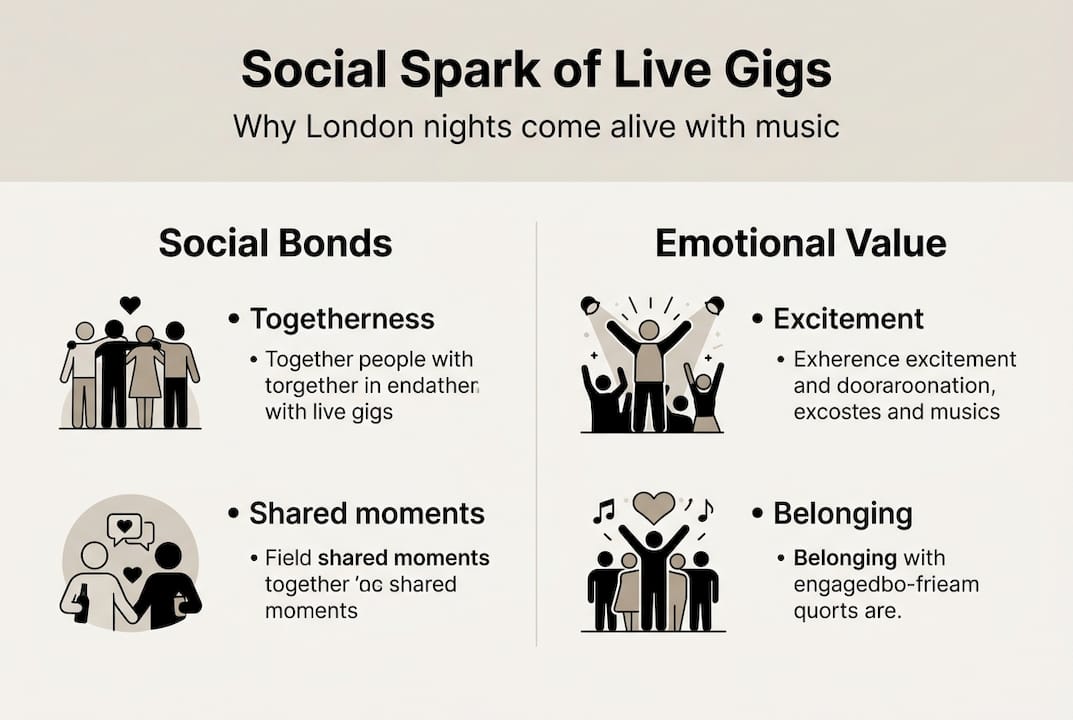
- Togetherness: Sharing a physical space and a collective emotional moment with others, strangers included.
- Escapism: Stepping away from the pressures of work and routine into an immersive environment.
- Discovery: Encountering new artists, sounds, or genres that feel personally meaningful.
- Being there: The irreplaceable sense of witnessing something live and unrepeatable.
- Uniqueness: The knowledge that no two performances are identical.
- Music-specific reasons: Pure appreciation for the craft, genre, or artist.
For event planners, these are not abstract concepts. They are design briefs. Build an event around togetherness and escapism, and you have already addressed the two most powerful reasons your guests showed up. The reasons to choose live music venues go well beyond acoustics or a performer’s setlist.
| Experience factor | Live music venue | Digital/streaming |
|---|---|---|
| Togetherness | Very high | Low |
| Escapism | High | Moderate |
| Discovery | High | Moderate |
| Uniqueness | Very high | Low |
| Emotional arousal | Very high | Low to moderate |
“The physical co-presence of an audience transforms music from a private pleasure into a shared cultural event. That transformation is irreplaceable.” — Cultural researcher, King’s College London
Designing events around these motivations is not a nice-to-have. It is the difference between a night people mention once and one they talk about for months.
The emotional spark: how live music heightens the night
The difference between hearing a song through earphones and experiencing it live is not just volume. It is physiological. A >Nature study on live music effects found that physical musician presence produces significantly greater emotional arousal, heart rate elevation, and positive emotional valence compared to livestreams of identical performances. Your body literally responds differently.
| Measure | Live performance | Livestream |
|---|---|---|
| Heart rate elevation | Significant | Minimal |
| Emotional arousal | High | Low to moderate |
| Memory formation | Strong | Weak |
| Appreciation rating | Very high | Moderate |
| Positive valence | High | Low to moderate |
For upscale venues, these findings are commercially significant. Stronger emotional arousal correlates with longer dwell time. Guests who feel more do not rush to leave. They order another round, linger over conversation, and return the following week. Understanding the role of music in bars is therefore not just an aesthetic question but a revenue one.
The live music satisfaction data reinforces this: 81% of UK adults prioritise experiences over material goods, meaning your guests are actively looking for reasons to feel something. Live music is the most reliable mechanism a venue has to deliver that.
Pro Tip: Book performers who interact directly with the audience, whether through banter, eye contact, or spontaneous improvisation. Real-time interaction amplifies emotional response and makes each guest feel personally included in the occasion.
The practical implication is clear. Background playlists keep a room ticking over. Live music transforms it into an occasion people feel compelled to be part of.
Community, identity, and status: the social value of live gigs
For London professionals, attending a live music event at an upscale venue is rarely just leisure. It carries social meaning. Live music fosters identity, community, and life milestones in ways that few other entertainment formats can match. When you choose a venue with a strong live music programme, you are signalling taste, cultural awareness, and social confidence.
The specific social rewards of live music attendance include:
- Network expansion: Shared enthusiasm for a performance creates natural conversation openers with strangers and colleagues alike.
- Status signalling: Being seen at the right venue with the right act carries genuine social currency in professional circles.
- Shared memory creation: Collective experiences become reference points that strengthen professional and personal bonds over time.
- Sense of belonging: Regular attendance at a venue builds familiarity and community, encouraging loyalty.
- Milestone marking: Birthdays, promotions, and deal closures feel more significant when anchored to a live performance.
“Live music in London is not just entertainment. It is a social infrastructure that professionals use to build relationships, celebrate achievements, and define who they are.” — Live music industry analyst
For event planners, the implications are direct. Integrating a signature live performance into a corporate event does not just entertain guests. It gives them a shared reference point that outlasts the evening. Explore live music networking opportunities and you will find that the most successful corporate functions treat the music as central, not peripheral.
Pro Tip: Commission or curate a performance that reflects your organisation’s character, whether that is a jazz trio for a law firm’s client evening or an acoustic singer-songwriter for a creative agency’s launch. The act becomes part of your brand story.
The role of live music in London’s nightlife is therefore as much sociological as it is entertainment-driven. Planners who understand this build events with genuine staying power.
Why London leads: the economic and practical case for live music
London does not just enjoy live music. It depends on it. >19% of London residents attend live music monthly, the highest rate of any UK city, and 85% consider concerts essential to city life. These are not passive fans. They are active, high-spending patrons who choose venues partly on the strength of their live music offering.

| Metric | London figure |
|---|---|
| Monthly live music attendance | 19% of residents |
| Value concerts as essential | 85% |
| UK live music economic impact | £6.1 billion |
| Jobs supported nationally | 30,000 |
The >UK live music economic impact hit a record £6.1 billion, with London accounting for a disproportionate share through out-of-city visitor spend and premium venue pricing. For venue managers, this is the commercial context within which every booking decision sits.
If you are arranging live music events in London, here is a practical framework to maximise impact:
- Define your audience motivation first. Are guests seeking togetherness, discovery, or escapism? Match the act to the dominant driver.
- Programme strategically. Mid-week performances can drive footfall on quieter nights. Weekend slots command premium spend.
- Promote the experience, not just the artist. Sell the occasion, the atmosphere, and the exclusivity.
- Gather feedback post-event. Patron responses to specific acts and genres sharpen your future programming.
- Build a regular series. Consistency creates anticipation and repeat visits, which is the foundation of patron loyalty.
London’s upscale venues are uniquely positioned to benefit because their clientele already expects premium experiences and is willing to pay for them.
A new era for venues: trends, challenges, and future opportunities
The London venue landscape is shifting. While grassroots music spaces face closures and rising costs, upscale venues are finding that >live music sustainability depends on evolving beyond a simple stage-and-bar model. The venues thriving in 2026 combine curated music with food, VIP packages, and multi-use flexibility.
Key trends shaping the sector include:
- Hybrid events: Blending in-person performances with digital elements to extend reach without diluting the live experience.
- Curated music programmes: Moving away from open bookings towards themed series that attract specific professional audiences.
- VIP and private hire integration: Offering exclusive access to live performances as part of corporate packages.
- Mood and tempo curation: Selecting acts and setlists that influence how long guests stay and how much they spend.
The top bar entertainment types increasingly reflect this sophistication. Venue managers are thinking like programmers, not just bookers.
The >nightlife trends in London also point to a growing appetite for exclusivity and personalisation. Guests want to feel that an evening was designed for them, not assembled from a generic template.
Pro Tip: Pair live music with a bespoke cocktail menu that reflects the genre or theme of the performance. A jazz evening with prohibition-era cocktails, for instance, creates a coherent sensory world that keeps guests engaged and spending longer.
For venues willing to invest in this kind of deliberate curation, the rewards are substantial. Footfall, dwell time, and average spend all respond positively to a well-programmed live music experience.
Why the power of live music is underestimated by even savvy event planners
Most event planners know that live music is a draw. Far fewer treat it as a precision instrument. The honest truth is that booking a band and calling it done is the minimum. The real opportunity lies in the details that most organisers overlook entirely.
Genre selection shapes the emotional temperature of a room. Tempo influences how quickly guests drink and how long they linger. Performer interaction, or the lack of it, determines whether guests feel included or merely entertained. These are not soft variables. They are measurable levers that affect revenue and recall.
Attendees rarely remember the specific songs played. They remember how the room felt, who they spoke to, and the sense that something genuinely special was happening. That memory is constructed by dozens of micro-decisions that most planners leave to chance. Choosing music genre and atmosphere deliberately is where elite event planning begins.
The planners who consistently deliver exceptional nights are the ones who treat live music programming as seriously as catering or guest lists. Evidence-led, intentional, and deeply attuned to what their specific audience actually wants.
Plan your next lively London event with the perfect soundtrack
You now have the evidence, the frameworks, and the practical tools to make live music work harder for your events and your venue. The next step is finding a space that already understands this language and has built its entire experience around it.
At The 1 Bar on Appold Street in the heart of London’s financial district, live music is not an afterthought. It is the centrepiece. Whether you are planning an after-work gathering, a private corporate function, or a celebratory evening, explore the role of live music in London and discover how a curated programme transforms a good night into an unforgettable one. For a deeper look at pairing cocktails with live performance, the guide to cocktail bars and live music is your essential starting point.
Frequently asked questions
What makes live music more engaging than recorded or streamed options?
Live music triggers stronger physiological and emotional responses than digital alternatives, including elevated heart rate and deeper memory formation. Physical musician presence produces measurably greater appreciation and emotional arousal than even high-quality livestreams.
How does live music influence networking at corporate events?
It creates a shared emotional experience that lowers social barriers and gives attendees natural conversation starters. The togetherness motivation identified in research makes live music uniquely effective at fostering genuine, relaxed interaction among professionals.
Is live music still popular in London compared to other UK cities?
Yes, London leads the UK convincingly. 19% of Londoners attend live music monthly, the highest rate nationally, and 85% consider concerts an essential part of city life.
Do certain types of live music work better for upscale venues?
Absolutely. Genre, tempo, and performance style can be matched to the occasion and clientele, with tempo and mood proven to directly influence how long guests stay and how much they spend.
How do venues balance the cost of live music with the benefits?
Most upscale London venues find that increased footfall, longer dwell times, and higher per-head spending comfortably offset booking costs. The £6.1 billion economic impact of UK live music reflects a sector where the returns, when managed well, are consistently strong.


