
Every London professional knows the difference between just another pub and a place where conversation flows and connections form naturally. The secret lies in how atmosphere is created, with music acting as the strongest influence on mood and experience. Research confirms that specific musical choices shape customer emotions, satisfaction, and even spending. Discover how mastering these elements transforms ordinary drinks into meaningful networking and unforgettable evenings.
Table of Contents
- Defining Bar Atmosphere And Music’s Influence
- Music Genres And Vibes: Aligning With Brand Identity
- How Volume, Tempo, And Timing Shape Guest Mood
- Impact On Socialising, Dwell Time, And Spend
- Operational Benefits And Common Mistakes To Avoid
Key Takeaways
| Point | Details |
|---|---|
| Bar Atmosphere is Intentional | Music, along with visual and social elements, is crucial in crafting a bar’s atmosphere, significantly affecting customer perception and experience. |
| Music Influences Spending and Dwell Time | Properly curated music enhances comfort, encouraging guests to stay longer and spend more, directly impacting revenue. |
| Genre Aligns with Brand Identity | The chosen music genre must align with the bar’s brand identity to attract and retain the target demographic effectively. |
| Volume and Tempo Matter | Optimal volume and tempo levels are essential for maintaining conversation and energising the environment throughout the evening. |
Defining Bar Atmosphere and Music’s Influence
Bar atmosphere isn’t something that happens by accident. It’s carefully constructed through multiple sensory elements, with music serving as the most powerful ingredient.
Think of atmosphere like the difference between a crowded commute on the Northern Line and a private meeting room. Same people, completely different experiences. Music creates that distinction in bars.
What Actually Makes a Bar’s Atmosphere
Atmosphere encompasses the entire environment you encounter upon entry. It’s the combination of lighting, décor, crowd energy, and crucially, sound.
How music affects customer emotions and satisfaction goes far beyond background noise. The right music shapes how guests perceive service quality, pricing, and their overall experience. A poorly chosen soundtrack can undermine even the finest cocktails.
Key elements that create atmosphere include:
- Visual design: Lighting, seating arrangements, and décor
- Sound environment: Genre, tempo, volume levels, and live versus recorded music
- Social energy: How crowded the space feels and crowd demographics
- Service quality: Staff behaviour and attentiveness
Most London professionals focus only on the first and last elements. They overlook sound entirely, which is why many corporate events feel flat.
Music’s Specific Role in Shaping Perception
Music functions as an emotional gateway. Music’s influence on how customers perceive bar experiences reveals that specific musical choices trigger emotional responses, which then alter cognitive judgements about the space itself.
When you hear an upbeat jazz track at 120 beats per minute, your brain interprets the environment as sophisticated and energetic. Slower, ambient music at 80 beats per minute signals relaxation and intimacy.
Musical elements that directly impact atmosphere:
- Tempo: Higher beats per minute (100+) energise; lower tempos (70-90) calm
- Volume: Conversation-level sounds allow networking; louder volume prevents dialogue
- Genre: Influences perceived sophistication, energy, and crowd demographic
- Dynamics: Live music creates spontaneity that recorded tracks cannot replicate
For post-work drinks with colleagues, you need tempo and volume that permits conversation whilst signalling this isn’t a typical office space. That’s the sweet spot.
Why This Matters to Your Experience
You’re not just drinking a cocktail. You’re paying for an experience where your brain feels a specific way about the space. Music controls how your mind interprets everything else.
A mediocre cocktail in the right atmosphere feels premium. A perfect cocktail in the wrong atmosphere feels wasted.
When music aligns with the venue’s intended atmosphere and your expectations as a guest, every other element—drinks, service, conversation—feels significantly better.
For corporate functions and networking, this becomes crucial. The music either facilitates conversation and connection, or it isolates guests into awkward silence or forces shouting.
Pro tip: When booking a venue for your team event, ask specifically about the music programme for your date and time—volume levels, whether it’s live or recorded, and how it adapts throughout the evening. The answer reveals whether they understand atmosphere design or simply play background noise.
Music Genres and Vibes: Aligning With Brand Identity
Your bar’s brand identity isn’t just about the logo or décor. It’s communicated through every sensory choice, particularly music. The wrong genre undermines your entire positioning.
Think of it this way: a craft cocktail bar playing heavy metal doesn’t work, regardless of how excellent the drinks are. Conversely, a relaxed neighbourhood pub playing classical symphonies feels misaligned. Music signals what kind of establishment you are before customers even order.
How Genre Shapes Customer Perception
Music type reinforces brand identity and attracts target demographics, meaning your genre choices directly influence who walks through the door and how long they stay.
Different genres communicate different messages to London professionals:
- Jazz and soul: Sophistication, networking-friendly, upscale perception
- Contemporary pop: Energy, social atmosphere, broad appeal
- Acoustic or indie: Intimate, conversational, authentic positioning
- Electronic or house: Modern, trendy, younger demographic focus
- Live music: Adds prestige and spontaneity across most genres
Your music genre becomes part of your brand promise. Customers choose venues partly based on whether the soundscape matches their expectations.
Here’s how different music genres align with bar positioning and customer expectations:
| Genre | Best For | Customer Perception |
|---|---|---|
| Jazz/Soul | Upscale cocktail bars | Sophisticated, networking friendly |
| Contemporary Pop | Social bars and lounges | Energetic, widely appealing |
| Acoustic/Indie | Intimate neighbourhood pubs | Relaxed, authentic, conversation-led |
| Electronic/House | Trendy, modern venues | Youthful, high energy, vibrant |
| Live Music (any) | Premium events or evenings | Unique, memorable, adds prestige |
Alignment Creates Loyalty
Aligning music genres with your brand identity enhances customer experience and directly correlates with how often guests return. People develop loyalty to venues where the entire experience feels coherent.
When you book a bar for post-work drinks, you’re partly choosing based on whether the music fits the occasion and your professional image. A venue with misaligned music feels chaotic and confusing, even if nothing is technically wrong.
The Live Music Advantage
Live music creates a distinct brand positioning that recorded music cannot replicate. It signals investment in experience, creates spontaneity, and generates conversation starters among your guests.
For London’s corporate professionals, live music at a networking event communicates that your organisation values quality and intentionality. It transforms a standard after-work gathering into something memorable.
Strategic music curation is not a luxury—it’s how venues communicate their identity and build customer loyalty within their target demographic.
Your genre choices tell a story about what your establishment stands for. That story either attracts or repels your ideal customer.
Pro tip: When planning a corporate event, ask venues not just what music they offer, but why they selected that genre—their answer reveals whether they strategically align music with brand identity or simply play whatever seems popular.
How Volume, Tempo, and Timing Shape Guest Mood
Music isn’t just background noise—it’s a behaviour modification tool. Three specific variables control how your guests feel and how long they stay: volume, tempo, and timing throughout the evening.
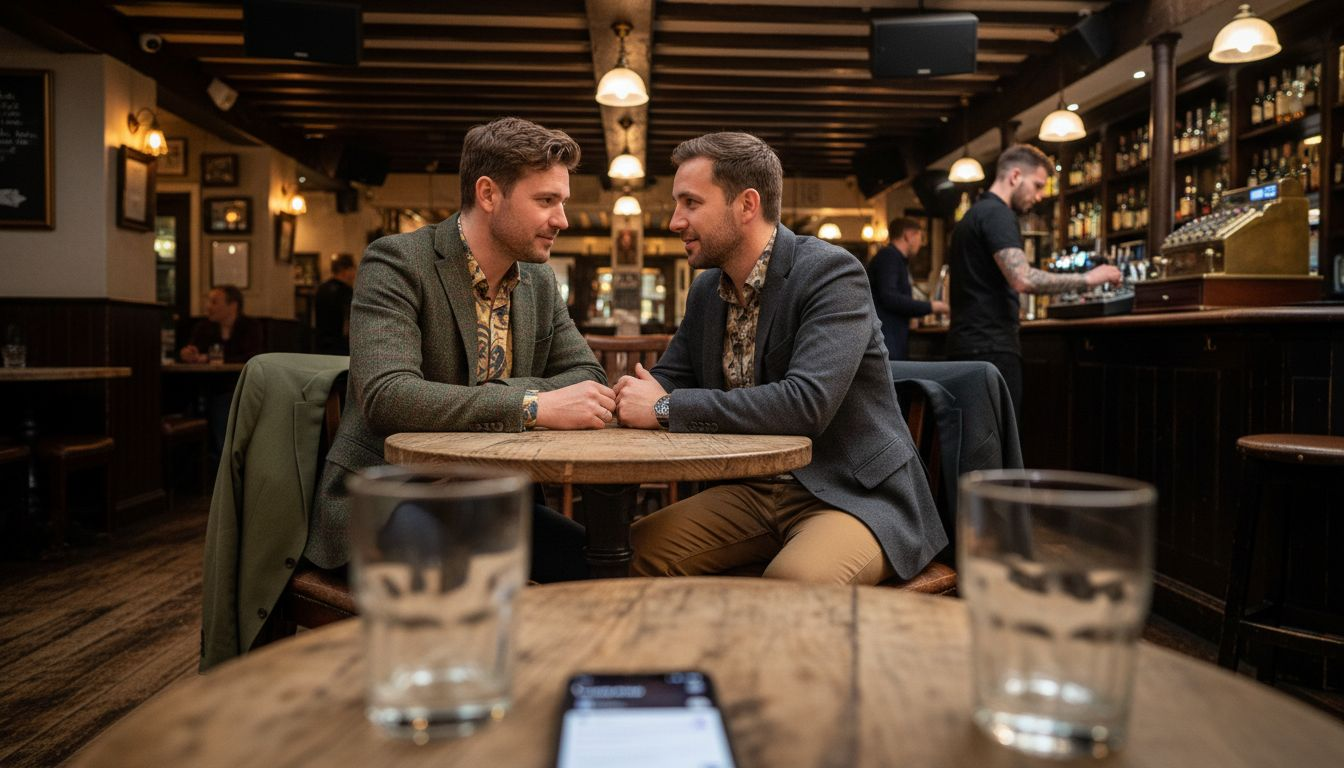
These aren’t subtle effects. They directly determine whether your networking event feels energised or exhausting, whether guests linger over one drink or order multiple rounds.
The Volume Question
Volume sets the baseline for the entire experience. Too loud, conversations die. Too quiet, the space feels empty regardless of how many people are there.
Volume and tempo directly affect how long guests stay and their purchasing behaviour, meaning your sound levels influence both satisfaction and revenue.
For London professionals seeking post-work drinks, optimal volume allows conversation at normal speaking levels. You should hear your colleague without leaning in. This is roughly 70-80 decibels—loud enough to feel lively, quiet enough for dialogue.
Volume also changes how people perceive time. Softer music makes minutes feel longer; guests linger. Louder music compresses time perception; people feel rushed.
Tempo Controls Energy Flow
Tempo measures beats per minute and directly influences your guests’ energy state. This isn’t psychological—it’s neurological.
Tempo guidelines for different bar phases:
- 70-90 BPM: Relaxation, conversation focus, extended dwell time
- 90-120 BPM: Social energy, balanced conversation and movement
- 120+ BPM: High energy, dancing, faster consumption, shorter visits
Faster tempos energise guests and accelerate spending. Slower tempos encourage lingering and conversation. Neither is inherently better—it depends on your evening’s objectives.
For networking events, 90-110 BPM creates the sweet spot: people feel energised but can still communicate.
Timing Across the Evening
The best bars modulate music strategically throughout their operating hours. What works at 5pm doesn’t work at 9pm.
A typical progression:
- Early evening (5-7pm): Moderate volume, 85-100 BPM—encourages post-work arrivals, conversation-friendly
- Mid-evening (7-10pm): Slightly increased volume and tempo, 100-120 BPM—builds momentum and social energy
- Late evening (10pm+): Peak volume and tempo if desired—signals shift toward dancing or higher-energy socialising
This progression guides your guests through different mood states naturally. It prevents the awkward silence of early evening from persisting all night.
Classical and jazz with moderate volume and tempo enhance relaxation and spending willingness, demonstrating that strategic musical choices directly influence customer satisfaction.
For corporate events, timing becomes critical. Start with conversation-conducive settings, then gradually increase energy as the evening progresses, matching your guests’ comfort levels.
Pro tip: Request a venue that actively adjusts music volume and tempo throughout your event duration—not static playlists. Ask them to begin around 85 BPM and gradually increase to 110 BPM by late evening, keeping volume conversation-permitting until at least 9pm.
Impact on Socialising, Dwell Time, and Spend
Here’s the financial reality: music directly influences how much money your guests spend and how long they stay. This isn’t theoretical—it’s measurable and consistent across hospitality venues.
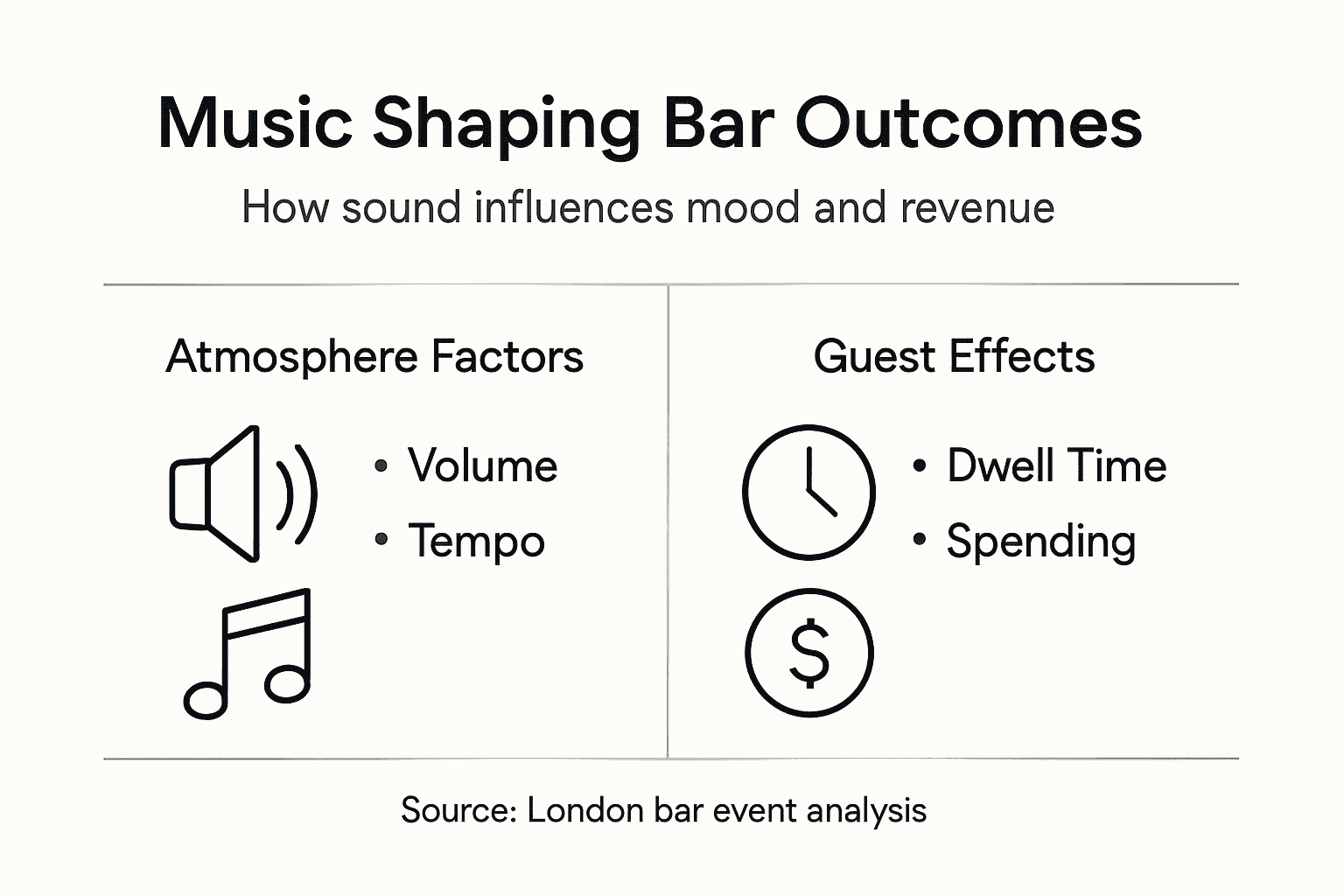
When you’re planning a corporate event or choosing a venue for team drinks, understanding these dynamics helps you select the right space and budget accordingly.
How Music Extends Dwell Time
Good music increases dwell time significantly, with 80% of patrons reporting they would stay longer if the music is enjoyable. That’s four in five people—a substantial majority.
Guests don’t consciously think “I’ll stay longer because of the soundtrack.” It works subconsciously. The right music makes time feel shorter and the environment feel more comfortable. You lose track of how long you’ve been there.
For London professionals, this means a well-curated bar keeps your group together longer. Nobody wants to leave when they’re genuinely enjoying the atmosphere.
The Connection Between Time and Spending
Longer dwell time directly correlates with higher spending. This is the mathematical reality: more time at the bar equals more rounds ordered.
Extended stays typically result in:
- Additional drink orders (typically 1-2 more beverages per person)
- Higher food expenditure if available
- Increased likelihood of repeat visits
- Better word-of-mouth recommendations
A guest planning to stay 90 minutes might spend £40-60. That same guest staying 2-3 hours typically spends £80-120 or more. Music is one of the primary factors that determines which scenario occurs.
Music as a Social Facilitator
Music fosters comfort and sociability, encouraging longer stays and increased expenditure. This happens because music provides a psychological backdrop that makes conversation feel more natural.
Without appropriate music, silence creates pressure. Conversation feels forced. With the right soundtrack, dialogue flows naturally, and groups bond more effectively.
For networking events, this is crucial. Music removes the awkwardness that kills networking by creating a social framework within which conversation happens more easily.
Volume and Genre Impact Spending Directly
Not all music produces equal spending. The type matters considerably.
Spending correlation by music type:
- Jazz or acoustic: Extended stays, higher spending per hour, better conversation quality
- Upbeat contemporary: Balanced approach, moderate spending increase, good energy
- High-tempo electronic: Shorter stays, accelerated consumption, higher per-drink spending but lower total spend
- Misaligned music: Reduced dwell time, lower spending, higher departure rates
Music that is well-suited to the environment and customer preferences directly increases spending through extended dwell time and enhanced comfort.
The genre you choose determines not just how people feel, but literally how much revenue is generated.
Pro tip: When budgeting for a team event, venues with well-curated, moderate-tempo music typically see guests stay 30-45 minutes longer than venues with poor music selection—budget accordingly for additional rounds and expect better return on investment from the venue choice itself.
Operational Benefits and Common Mistakes to Avoid
Music is one of the cheapest operational tools available to improve customer satisfaction and revenue. Yet most venues handle it poorly, undermining their entire experience.
Understanding what works and what fails prevents costly mistakes that drive guests away.
The Operational Advantage
Properly managed music programming increases customer satisfaction, longer patron visits, and higher revenues. This isn’t an optional extra—it’s a direct business lever.
Music costs nothing to implement once you’ve invested in basic sound equipment. Yet it delivers measurable returns through extended dwell time and increased spending. Few marketing investments offer this ratio.
For venues like The 1 Bar, strategic music programming becomes a competitive differentiator. It’s why some bars are always full whilst others struggle despite identical locations.
Common Mistakes That Damage Experience
Most venues fail not through ambition but through avoidable errors.
The biggest mistakes include:
- Mismatched genre: Jazz in a modern cocktail bar or electronic in a traditional pub signals confusion about brand identity
- Excessive volume: Kills conversation and forces guests to leave—the opposite of desired behaviour
- Ignoring demographics: Playing TikTok hits to wealthy professionals aged 35-55 creates friction and early departures
- Static playlists: Same music from 5pm to midnight fails to evolve with crowd energy
- Live music quality issues: Poor performers damage reputation more than recorded music ever could
- No audio equipment investment: Bad speakers make even good music sound mediocre
Music genres, volume, and timing errors directly reduce satisfaction and dwell time, proving that execution matters as much as intention.
One poorly chosen evening’s playlist can damage a venue’s reputation through word-of-mouth.
What Works Operationally
Successful venues treat music as strategic rather than afterthought. They follow clear principles:
- Define brand audio identity: Specify genre, tempo range, and volume targets in writing
- Know your audience: Understand target demographics and their music preferences
- Invest in quality: Good speakers and sound systems matter more than many realise
- Curate intentionally: Hand-select playlists rather than using generic pre-built ones
- Monitor and adjust: Track which nights and timing produce best results
- Vet live performers: Audition musicians before booking—talent varies enormously
Venues that follow these practices see measurable improvements within weeks.
The table below compares bar music operational errors with best practices for lasting business impact:
| Common Mistake | Result | Best Practice | Outcome |
|---|---|---|---|
| Mismatched genre | Guest confusion | Align genre with brand | Consistent identity |
| Excessive volume | Reduced conversation | Set conversation-level volume | Guests stay and engage longer |
| Static playlists | Flat energy | Adjust playlists by time slot | Enhanced mood and dwell time |
| Ignoring demographics | Early departures | Tailor to target customers | Higher satisfaction and loyalty |
Why Corporate Events Succeed Here
For London professionals planning team events, understanding these principles helps you select better venues. Ask potential venues about their music strategy—their answer reveals whether they understand atmosphere design.
Venues that can articulate their music approach typically deliver better overall experiences.
Music is a cost-effective tool to enhance customer experience when applied thoughtfully, whilst errors in execution significantly reduce satisfaction.
The venues that succeed invest in this fundamentally.
Pro tip: Before booking a venue for your corporate event, ask three questions: What is your music selection process? Can you describe your typical music progression through the evening? Have you adjusted your music based on guest feedback? Their answers determine whether they actively manage atmosphere or simply tolerate background noise.
Elevate Your Event Atmosphere with Expert Music Curation at The 1 Bar
Creating the perfect atmosphere means mastering the art of music — from tempo and volume to genre alignment and timing throughout the evening. If you have struggled with venues playing ill-fitting soundtracks or excessive volume killing conversations, The 1 Bar offers a solution designed for London professionals who value sophisticated, conversation-friendly environments. Our live music performances and carefully curated playlists ensure every after-work gathering or corporate event unlocks the emotional connection that turns a drink into a memorable experience.
Discover how intentional music choices transform your event atmosphere by visiting The 1 Bar. Explore our drinks menu and private hire options tailored to elevate your team’s networking or celebration. Don’t settle for background noise that undermines your occasion — book now to create an environment where your guests feel energised, engaged, and ready to stay longer.
Frequently Asked Questions
How does music influence the atmosphere in a bar?
Music plays a crucial role in shaping the atmosphere of a bar by affecting customer emotions and perceptions. The right musical choices can enhance the overall experience, making guests feel more relaxed, energetic, or engaged, thus influencing their satisfaction and spending.
What elements affect the musical atmosphere in a bar?
Key elements that create a musical atmosphere in a bar include the volume, tempo, genre of music, and whether the music is live or recorded. Each of these factors contributes to how the environment is perceived and how customers interact within it.
Why is genre important for a bar’s brand identity?
The choice of music genre helps communicate a bar’s brand identity before customers even place their orders. Different genres convey distinct messages; for instance, jazz suggests sophistication while pop indicates a social atmosphere. Misaligned genres can confuse customers and affect their overall satisfaction.
How does volume impact guest spending in bars?
Volume significantly influences guest behaviour. The optimal volume allows for normal conversation, encouraging guests to stay longer, which in turn leads to higher spending. If the music is too loud, it can drive guests away, while music that is too quiet may result in a lack of energy in the space.